How Long Does Hot Dip Galvanizing Last?
Galvanized steel lasts as long as its zinc coating. Here is how to estimate that from ISO 1461 coating thickness and ISO 9223 exposure category — with a worked example and what the model does not cover.
Hot dip galvanizing protects steel for as long as the zinc coating lasts. Because zinc corrodes at a slow, well-characterised rate, the service life of a galvanized structure can be estimated before the steel is fabricated — you need two numbers: the thickness of the coating, and the corrosivity of the place the structure will stand.
How long does hot dip galvanizing last?
A hot dip galvanized coating lasts roughly as long as its thickness divided by the local zinc corrosion rate. A 70 micrometre coating on a truss member in an ordinary urban environment, where zinc is lost at about 1.4 micrometres per year, gives around 50 years before first maintenance. The same coating in a heavy industrial or marine setting may last closer to 11 years.
That single division is the whole model. Everything else is working out which two numbers apply to your structure.
The two inputs that decide service life
Coating thickness comes from the steel thickness
Under ISO 1461, the minimum mean coating thickness is set by how thick the steel section is, not by what the client asks for. Thicker steel holds more heat in the zinc bath and grows a thicker alloy layer.
| Steel section thickness | Minimum mean coating | Typical members |
|---|---|---|
| Under 1.5 mm | 45 µm | Light gauge sheet, cladding fixings |
| 1.5 mm to 3 mm | 55 µm | Purlins, light angles, brackets |
| 3 mm to 6 mm | 70 µm | Truss members, tower sections |
| Over 6 mm | 85 µm | Plate girders, heavy structural members |
A practical consequence: a light bracing angle on the same bridge as a heavy plate girder will reach the end of its coating life sooner. Where a structure mixes section thicknesses in one exposure zone, the thinnest member sets the maintenance interval.
Corrosivity comes from the site
ISO 9223 classifies atmospheric corrosivity into categories from C1 to C5, each with a measured range of first-year zinc loss.
| Category | Environment | Typical zinc loss |
|---|---|---|
| C2 | Rural, low pollution | 0.4 µm/year |
| C3 | Urban and suburban | 1.4 µm/year |
| C4 | Industrial or coastal | 3.2 µm/year |
| C5 | Heavy industrial or marine | 6.3 µm/year |
The figures above are mid-range values for each category. ISO 9223 gives bands rather than single numbers, so treat any calculated life as an estimate with a margin either side, not a guarantee.
Working an example
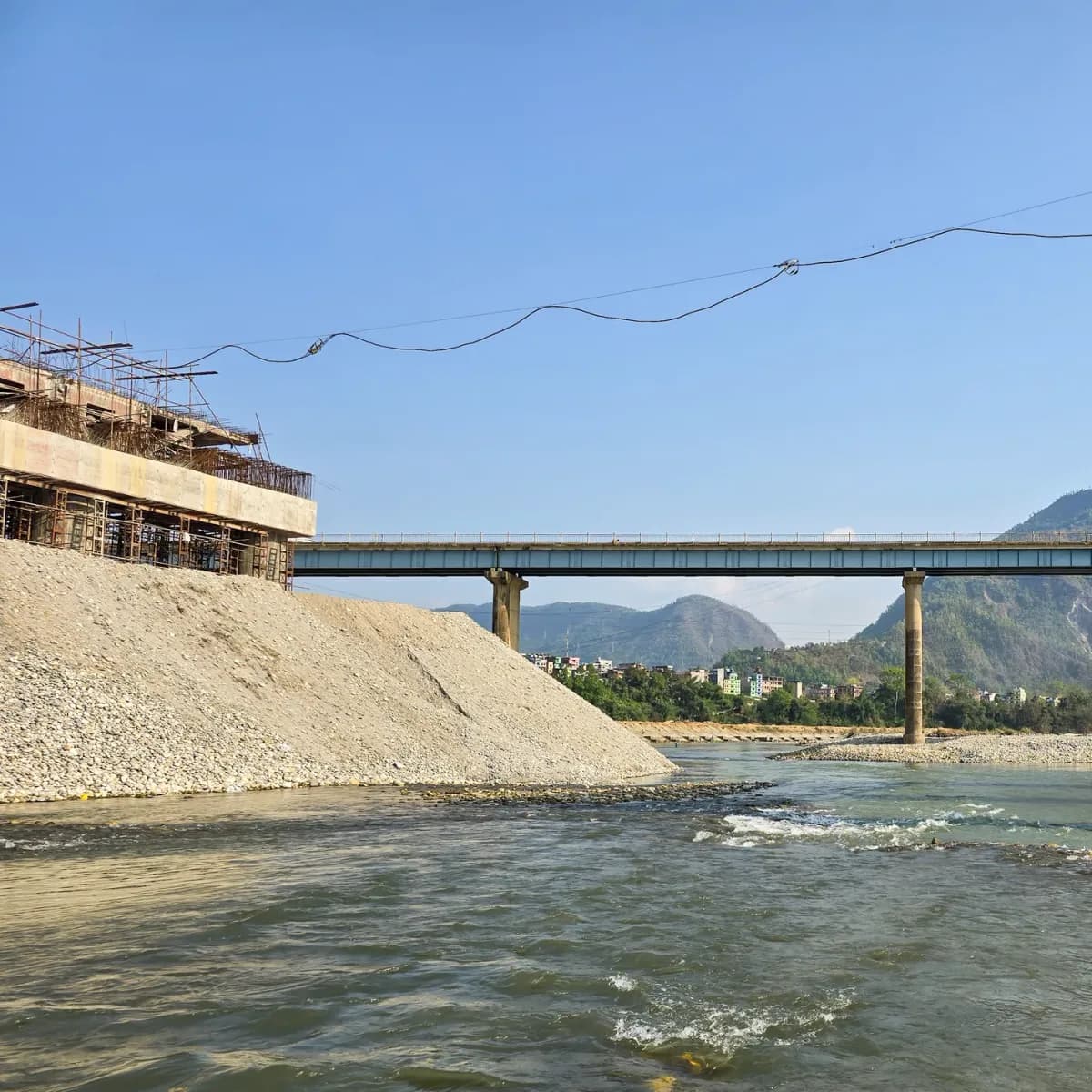
Take a steel truss bridge with main members fabricated from 8 mm plate, standing over a river in a rural hill district.
- Steel thickness is over 6 mm, so the minimum mean coating is 85 µm.
- The setting is rural with low industrial pollution, which is category C2 at about 0.4 µm per year.
- 85 divided by 0.4 gives roughly 210 years to first maintenance.
Change one input and the answer moves sharply. Put the same bridge beside a cement plant, in category C4 at 3.2 µm per year, and the estimate falls to about 27 years.
You can run this calculation for your own sections using the galvanizing service life calculator on our capabilities page.
What the estimate does not cover
Service life models describe uniform atmospheric corrosion. Several things fall outside them:
- Water traps. Sections that hold standing water corrode faster than the exposed-face model predicts. Drainage holes and free-draining details matter more than a few extra micrometres of zinc.
- Buried or immersed steel. Soil and water are different exposure environments with their own corrosion rates. ISO 9223 covers atmospheres only.
- Mechanical damage. Handling, transport and erection can strip zinc locally. Damaged areas need repair to the same coating thickness before handover.
- Bimetallic contact. Zinc in contact with more noble metals such as copper or stainless steel corrodes preferentially. Isolate the connection.
- Contact with wet timber or acidic run-off. Both accelerate zinc loss well beyond the atmospheric rate.
Nepal-specific considerations
Nepal's exposure conditions vary sharply over short distances, and the category that applies is a site question rather than a national one.
- Monsoon wetness matters more than rainfall totals. Corrosion rate tracks time-of-wetness, the number of hours a surface stays damp. A shaded valley crossing that dries slowly can corrode faster than a sunnier site with higher annual rainfall.
- Hill and mountain sites are usually rural. Away from industry and the highway corridor, category C2 is common, which is why galvanized trail bridge components last so well.
- Industrial corridors are harsher. Sites near cement works, brick kilns or dense traffic sit at C3 or C4.
- Remote sites raise the cost of maintenance, not just the risk. Where getting a crew and equipment to the structure is expensive, a longer maintenance interval is worth more than the marginal cost of thicker steel.
Specifying for a target service life
If a project needs a defined interval before first maintenance, the practical levers are, in order of usefulness:
- Choose the section thickness deliberately. Moving a member from 5 mm to 7 mm plate lifts its coating from 70 µm to 85 µm, a 21% gain in life at that exposure.
- Design out water traps. This costs nothing at the drawing stage and is the single largest avoidable cause of early failure.
- Specify a heavier coating where justified. ISO 1461 sets minimums, not maximums. A heavier coating can be agreed, but it must be written into the order.
- Consider a duplex system. Paint over galvanizing in a C4 or C5 environment lasts longer than the sum of the two systems used separately.
Frequently confused terms
Galvanizing is not painting. Zinc protects steel in two ways: it is a physical barrier, and it is sacrificial. If the coating is scratched through to bare steel, the surrounding zinc corrodes preferentially and the exposed steel does not rust. Paint offers no such protection at a scratch.
Single-dip and double-dip describe handling, not coating class. Double-dipping is used when a section is longer than the zinc bath and has to be immersed in two operations. It affects appearance at the overlap; it is not a thicker coating grade.
Mean coating thickness is not minimum local thickness. ISO 1461 specifies both. The mean is the figure used for service life estimates; the local minimum is a rejection criterion at inspection.
Frequently asked questions
- Can hot dip galvanizing be repaired if it is damaged during erection?
- Yes. ISO 1461 allows damaged areas to be renovated up to a defined proportion of the surface, using zinc-rich paint, zinc spray or a zinc alloy stick, built up to at least the specified local coating thickness. Ordinary silver paint is not a valid repair — it provides no cathodic protection.
- Does a thicker zinc coating always mean a longer life?
- Within the same exposure environment, yes — service life is proportional to coating thickness. But coating thickness is governed by the steel section thickness under ISO 1461, so the practical way to gain life is to choose a thicker section or agree a heavier coating explicitly at order stage.
- What is the difference between single-dip and double-dip galvanizing?
- Double-dipping means the article is longer than the zinc bath and has to be immersed from one end and then the other. It is a handling method, not a heavier coating grade. It can leave a visible overlap line where the two immersions meet.
- Does galvanizing protect steel that is buried or under water?
- The ISO 9223 corrosion rates used in service life estimates describe atmospheric exposure only. Soil and immersion are separate environments with their own corrosion behaviour, and need to be assessed separately rather than using an atmospheric category.
Sources and standards
About the author
Safe Steels Engineering Team
Fabrication, galvanizing and erection
Written and reviewed by the engineering staff at Safe Steels Pvt. Ltd., a mechanical and structural steel fabricator, galvanizer and erector operating a 12,500 m² facility at Chainpur-1, Chitwan. The team works to ISO 1461 for hot dip galvanizing and verifies material through the Central Material Testing Laboratory, Lalitpur.
More about Safe Steels