Steel Truss vs Plate Girder Bridges
Two ways to cross the same gap. A comparison on span, self weight, fabrication, transport and galvanizing — and why access to the site, not structural efficiency, usually settles it in Nepal.
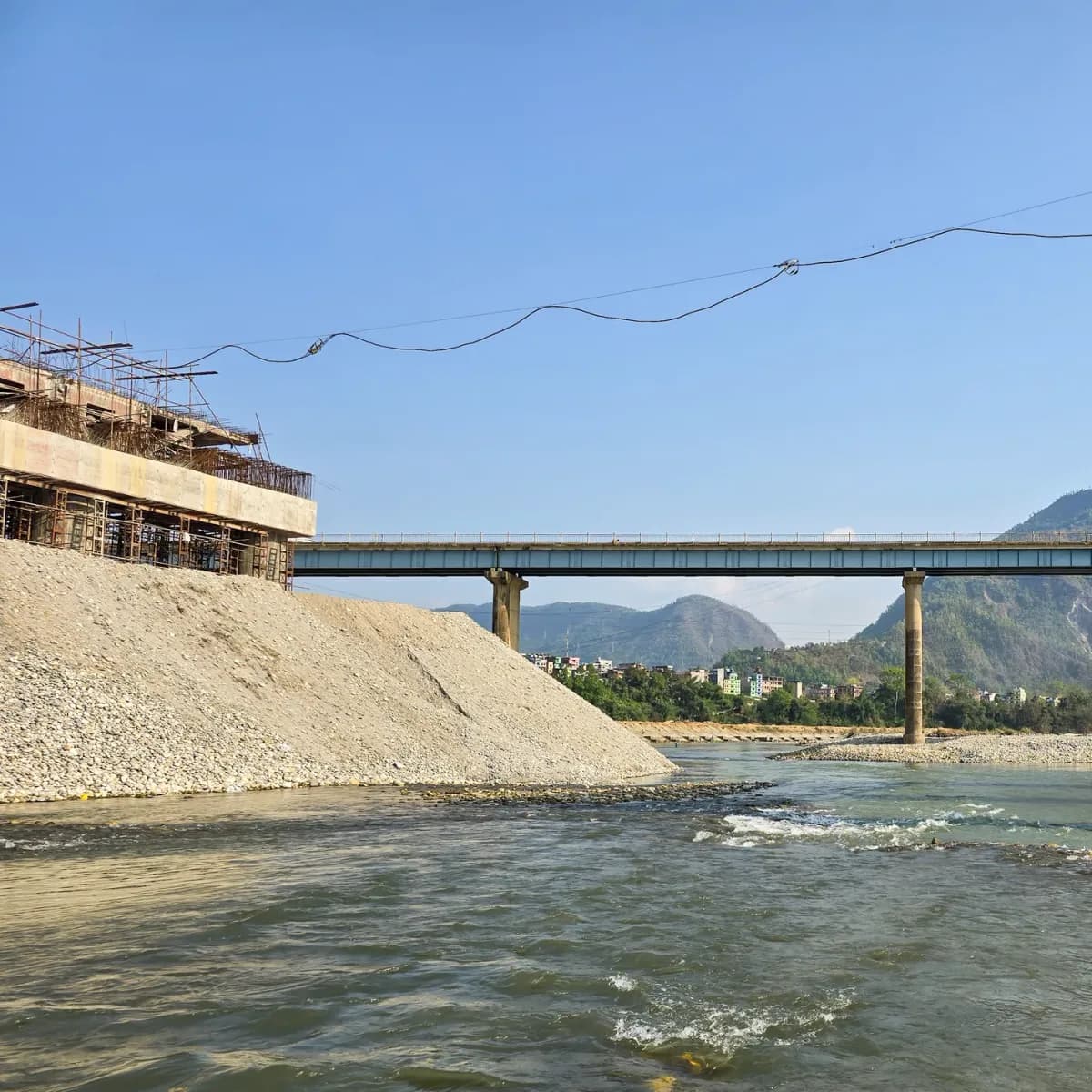
Steel truss and plate girder bridges solve the same problem with opposite strategies. A truss carries load through many small members arranged in triangles; a plate girder carries it through two heavy flanges and a web. Choosing between them is mostly a question of span, transport and site access — which, in Nepal, often decides the answer before structural efficiency does.
Truss or plate girder: which should you use?
Steel truss bridges suit longer spans, remote sites and situations where components must be carried in and assembled by hand, because the structure breaks down into small pieces. Plate girder bridges suit shorter spans with road access and lifting plant, because they are simpler to fabricate and erect but arrive as very heavy single elements.
How each one works
The truss
A truss resolves bending into axial forces. Top chord members go into compression, bottom chord members into tension, and the diagonals and verticals carry shear between them. Because each member does one job, material sits only where it is needed and the structure is light for its depth.
The cost is joints. A truss has a great many connections, and every one has to be detailed, fabricated, and inspected.
The plate girder
A plate girder is a deep I-section built up from plate: two flanges welded to a web, usually with stiffeners to stop the web buckling. Bending is carried almost entirely by the flanges; the web carries shear and holds the flanges apart.
There are far fewer connections, so fabrication is simpler and faster. The penalty is weight, since the web is largely material working well below capacity.
Comparison
| Factor | Steel truss | Plate girder |
|---|---|---|
| Efficient span range | Medium to long | Short to medium |
| Self weight | Lower for a given span | Higher |
| Fabrication complexity | High — many connections | Lower — repetitive welding |
| Transport | Breaks into small members | Long, heavy single elements |
| Erection plant | Can be assembled piece by piece | Usually needs cranes |
| Site access needed | Modest | Good road access |
| Inspection burden | Many joints to check | Fewer, longer welds |
| Maintenance surface area | Large | Smaller |
| Galvanizing | Members usually fit standard baths | Long girders may need double-dipping |
Why access usually decides it in Nepal
For a bridge on the highway network with crane access, the comparison is largely structural and economic. Away from the highway corridor it often is not.
A truss can be carried to site in pieces that fit a small truck, a tractor trailer, or in the hardest cases porters and mules. It can then be assembled in place, sometimes by launching it across the gap without a crane. That is why truss and trail bridge forms dominate hill and mountain crossings.
A plate girder for the same span may be a single element weighing several tonnes, needing a road capable of taking it and plant at both ends. Where that road does not exist, the girder is not a cheaper option — it is not an option.
This is the practical reason our own delivered record is weighted toward trusses: more than 15 steel truss bridges and over 40 trial bridges, against 3 plate girder bridges.
Galvanizing implications
The two forms behave differently in the zinc bath, and this belongs in the decision rather than being discovered later.
Truss members are usually short enough to be dipped in a single immersion. Our 8.0 m vat takes most truss chords and diagonals whole. The large number of connections does mean more edges and more places for zinc to pool, so drainage detailing matters.
Plate girders are frequently longer than any bath. A girder over 8.0 m has to be double-dipped, immersed from one end and then the other, which leaves a visible overlap and requires care to avoid distortion. The alternative is to splice on site, which reintroduces connections and site work.
If a long girder is unavoidable, confirm the galvanizer's bath length before the drawings are finalised. Redesigning a girder because it will not fit the bath is an expensive late change.
Maintenance over the life of the structure
A truss has more surface area per tonne of steel and many more crevices, so there is more to inspect and more to recoat. A plate girder has less surface and fewer traps.
Against that, a truss is easier to repair member by member. A corroded diagonal can be replaced; a corroded girder web is a much larger intervention.
Where access for future maintenance is poor — the common case for remote crossings — the sensible response is to specify for a long first-maintenance interval rather than to plan on frequent recoating. That means galvanizing, careful drainage detailing, and section thicknesses chosen with the coating service life in mind.
A short decision sequence
- Establish the clear span and the loading. This sets the feasible range for both forms.
- Survey the access route, not just the site. Bridge width, road curvature and load limits along the whole route decide the largest element that can arrive.
- Confirm the erection method. Crane, launch, or hand assembly.
- Check bath length against the longest element. Before drawings are frozen.
- Compare fabricated cost, not steel weight. A truss uses less steel but more labour; the two often land closer than the tonnage suggests.
- Weigh whole-life maintenance against access. Remote sites justify spending more up front on coating life.
Steps 2, 3 and 4 are the ones most often left until after the structural choice is made, and they are the ones most likely to force a redesign.
For a scope, galvanizing plan and delivery schedule against your drawings and tonnage, send us the details.
Frequently asked questions
- Which is cheaper, a truss or a plate girder?
- A truss uses less steel but far more fabrication labour because of the number of connections; a plate girder uses more steel but is simpler to weld. Compare fabricated and delivered cost rather than tonnage — for medium spans the two are often closer than the steel weight suggests.
- What span suits a steel truss bridge?
- Trusses become efficient once the span is long enough that a solid web girder would be uneconomically heavy, and they remain workable well beyond girder range. The decisive constraint is often transport and erection access rather than the span itself.
- Can a plate girder be hot dip galvanized?
- Yes, but girders longer than the zinc bath must be double-dipped, which leaves an overlap line and needs care to avoid distortion. Confirm the galvanizer's bath length before finalising girder lengths — our own vat is 8.0 m.
- Why are truss bridges common in Nepal's hill districts?
- A truss breaks down into members small enough to be carried to sites without road access and assembled in place, sometimes without a crane. A plate girder for the same span may be a single multi-tonne element that simply cannot reach the site.
Sources and standards
About the author
Safe Steels Engineering Team
Fabrication, galvanizing and erection
Written and reviewed by the engineering staff at Safe Steels Pvt. Ltd., a mechanical and structural steel fabricator, galvanizer and erector operating a 12,500 m² facility at Chainpur-1, Chitwan. The team works to ISO 1461 for hot dip galvanizing and verifies material through the Central Material Testing Laboratory, Lalitpur.
More about Safe Steels